
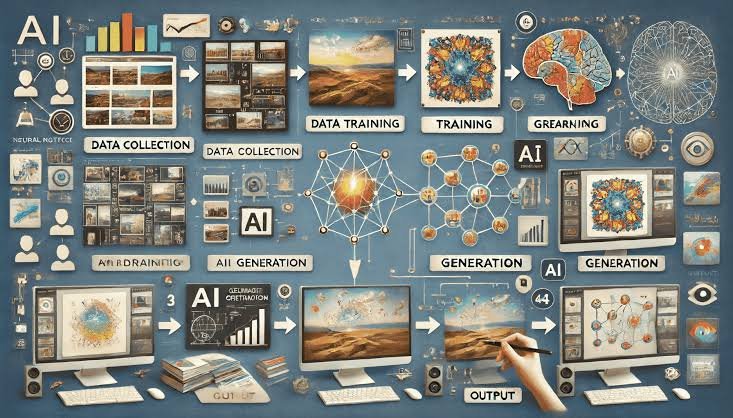
Imagine describing a scene in words—”a golden retriever puppy playing in a sunlit meadow”—and watching a unique, never-before-seen image appear on your screen in seconds. This is the magic of AI image generation, a technology that has moved from science fiction to everyday reality.
The Core Technology: How It Works
At the heart of modern AI image generation lies a technique called diffusion. This process, which powers tools like Stable Diffusion, DALL-E, and Midjourney, works through a fascinating process of reversal .
Training: Teaching the AI to “See”
The journey begins with training on massive datasets containing billions of image-text pairs, such as the LAION-5B dataset which has approximately 5.85 billion pairs . During this training phase:
- Adding Noise: The AI takes images from this dataset and progressively adds “noise” (random static) to them until they become unrecognizable .
- Reversing the Process: The model then learns to reverse this process—starting from pure noise and gradually removing it to reconstruct the original image .
- Learning Patterns: Through millions of examples, the AI learns the relationship between words and visual features, understanding that “dog” relates to certain shapes, colors, and patterns .
This training often takes months and requires enormous computing power .
Generation: From Prompt to Picture
When you enter a text prompt, the AI follows these steps:
Step 1: Understanding Your Prompt
The model uses a text encoder (like CLIP) to convert your words into numerical vectors that capture their meaning . This process, called tokenization, transforms “a serene Japanese garden with cherry blossoms” into a mathematical representation the AI can work with .
Step 2: Starting from Noise
The generation begins with pure random noise—essentially TV static . This noise serves as the blank canvas .
Step 3: Iterative Denoising
This is where the magic happens. The AI works through multiple steps (typically 20-50 iterations) to gradually remove noise from the image . At each step:
- The model predicts what noise should be removed to make the image align with your prompt .
- It compares the current image against your description .
- It subtracts the predicted noise, revealing more structure .
Think of it like a sculptor starting with a block of marble (noise) and chipping away until a statue (your image) emerges.
Step 4: Decoding the Final Image
Once the noise removal is complete, the image exists in a compressed format called “latent space”—essentially a compact representation capturing only the essential features . A decoder then expands this to create the full-resolution image you see .
Popular AI Image Generation Tools
Stable Diffusion
Launched in August 2022 as an open-source model, Stable Diffusion stands out for its speed. It uses a technique called “latent diffusion” that compresses images to one-fiftieth of their original size before processing, making it much faster than traditional diffusion models . It’s freely available for research and noncommercial use .
DALL-E (OpenAI)
One of the earliest major text-to-image models, DALL-E has evolved significantly. The latest version, GPT Image 2, excels at instruction following, photorealism, and rendering readable text within images—a common challenge for earlier models .
Grok Imagine Image (xAI)
This model generates images in about 4 seconds and handles diverse styles from photorealistic to anime. It’s particularly good at rendering readable text, making it useful for graphics with typography .
Google Imagen 4
Google’s offering supports multilingual prompts and offers variants optimized for different needs—”Fast” for speed and “Ultra” for maximum photorealism .
Key Technical Concepts
Latent Space Efficiency
Traditional diffusion processes work directly on pixel space, which for a 512×512 image with RGB colors means over 780,000 dimensions . Latent diffusion compresses this by 50x, working in a much smaller space before decoding back to full resolution .
The Role of U-Net and CLIP
The U-Net is the core denoising network that predicts what noise to remove. CLIP acts as the guide, helping the U-Net create images that align with your prompt . The two work together like an artist (U-Net) with a client giving directions (CLIP).
Samplers and Schedulers
These control the denoising process—how many steps to take, how much noise to remove at each step, and what strategy to use. Different samplers (like Euler, DPM++) produce different styles and qualities .
Prompt Engineering: The Art of Getting Good Results
Your prompt quality directly determines image quality. Here are key principles:
Be Specific: “A golden retriever puppy playing in grass, sunny day, shallow depth of field” works better than “a dog” .
Describe Style and Mood: Mention “oil painting,” “photorealistic,” “cyberpunk,” or “soft morning light” to control aesthetics .
Use Photo Language: For realistic results, try “shot with a 50mm lens, soft daylight, shallow depth of field” .
Quoted Text for Readability: When you want readable text in images, put it in “quotes” and describe typography .
Iterate: Start with a basic prompt, then refine based on results. Each iteration teaches you how to get closer to what you want .
Editing and Beyond
Modern AI image models go beyond generation from scratch. Many now support:
- Image-to-Image Editing: Upload an image and describe changes to alter style, add elements, or transform it entirely .
- Style Transfer: Apply the visual style of one image to another .
- Character Consistency: Generate multiple images where characters look the same across scenes .
- Multilingual Support: Models like Imagen 4 process prompts in languages including Hindi, Chinese, Japanese, and Spanish .
Challenges and Considerations
Despite the impressive capabilities, AI image generation faces limitations:
- Bias: Models reflect biases in their training data. If trained primarily on Western images, they may struggle with other cultural contexts .
- Ethical Concerns: Copyright issues and deepfake creation remain significant challenges .
- Technical Limitations: Even advanced models sometimes struggle with hands, fingers, and fine details .
- Computational Cost: Generating high-quality images requires significant computing power .
Conclusion
AI image generation represents a remarkable convergence of natural language processing and computer vision. What once required years of artistic training can now be achieved with a few well-chosen words. Whether you’re a designer prototyping concepts, a developer generating training data, or simply exploring creative expression, understanding how these systems work helps you harness their power more effectively .
The technology continues to evolve rapidly—with faster generation times, better photorealism, and more precise editing capabilities arriving regularly. As these tools become more accessible and capable, they’re not just changing how we create images, but fundamentally expanding what’s possible for anyone to visualize.